
Ana Reis · Educational content
Three-card Tarot spread: a method and worked example
Learn a three-card spread with defined positions, a worked example about work and an exercise to assess your interpretation.
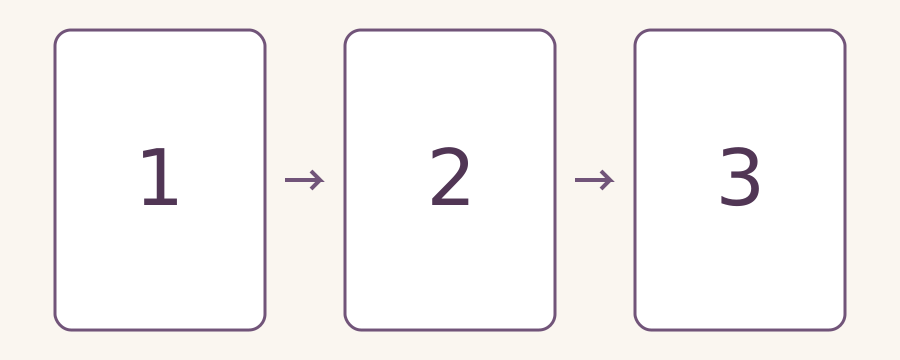
A three-card spread lets you practise the relationship between a question, positions and symbols without spreading your attention across a complex layout. Here we use situation, difficulty and possible action. It is an invitation to reflect, with no guaranteed prediction.
When to use this layout
Use it for a specific issue, such as preparing a conversation or considering a decision. Avoid combining several subjects in one reading. If you want a diagnosis, a financial guarantee or private information about someone else, this method is unsuitable.
Before shuffling, write down the question and three functions: position 1, situation; position 2, a difficulty to explore; position 3, possible action. The layout above reads from left to right. Defining the positions before drawing avoids adapting the method to the result you want.
Example: a new work opportunity
Question: “What factors should I consider before accepting a work opportunity?” Example cards: the Fool in the situation, the Emperor in the difficulty and the Six of Coins in possible action. These cards were chosen to demonstrate the process. This is a fictional example, not an account of a consultation.
First position: the Fool
Observe the moving figure. In the situation position, we can explore the wish to move forward, novelty and willingness to experiment. The work context makes it useful to ask what attracts the person to the opportunity. The image alone does not confirm that the job will be good or should be accepted.
An initial hypothesis might be: there is an impulse to change, but part of the path remains unknown. Concrete information about duties, conditions and expectations would help assess that idea.
Second position: the Emperor
Here the card occupies the difficulty. We should not automatically decide that it represents a man or an authoritarian boss. The structure and control associated with the figure may draw attention to rules, stability or rigidity.
Connecting this position with the first, the wish to explore may conflict with a need for security. The person might need clearer conditions before proceeding. Another hypothesis is that a rigid structure makes adaptation difficult. The reported context helps distinguish these possibilities.
Third position: the Six of Coins
In Marseille, observe the arrangement of the six objects; do not automatically import a coin-giving scene from another deck. In this exercise, we use Coins as a symbolic framework for resources and six as organisation or adjustment. In the action position, the proposal is to evaluate a balanced exchange: time, pay, responsibilities and support.
One concrete action would be to prepare a list of conditions to clarify and ask who supports the induction. This is not investment advice or a guarantee of financial gain.
Build a synthesis
One possible synthesis is: “Newness seems important to you. Before deciding, check whether your wish to move forward is supported by clear conditions. Compare what you will give with what you will receive and identify the available support.” This conclusion connects movement, structure and resources; it does not come from three isolated keywords.
What if the cards seem to contradict each other?
Cards with different movements can reveal a useful tension. Moving forward and creating stability need not exclude each other: you can experiment through a small step with defined limits. Do not keep drawing until you get your preferred answer. Record two hypotheses and identify what real information would distinguish them.
An exercise with self-checking
Draw three cards for “How can I prepare for an important conversation?” Keep the situation, difficulty and action functions. Write one visual observation and one hypothesis for each card, then build a four-sentence synthesis.
Check four criteria: did you answer the question, respect the positions, explain the relationship between at least two cards and suggest a possible action without promising a result? Rework anything missing. The aim is to support the reading, not to find a perfect sentence.
Review the Tarot de Marseille foundations or explore other layouts in the Tarot spreads course. Course lessons and materials are in Portuguese.