
Ana Reis · Educational content
Tarot de Marseille for beginners: how to start learning
Discover the structure of the 78 Tarot de Marseille cards and learn to observe, ask questions and practise with a simple method.
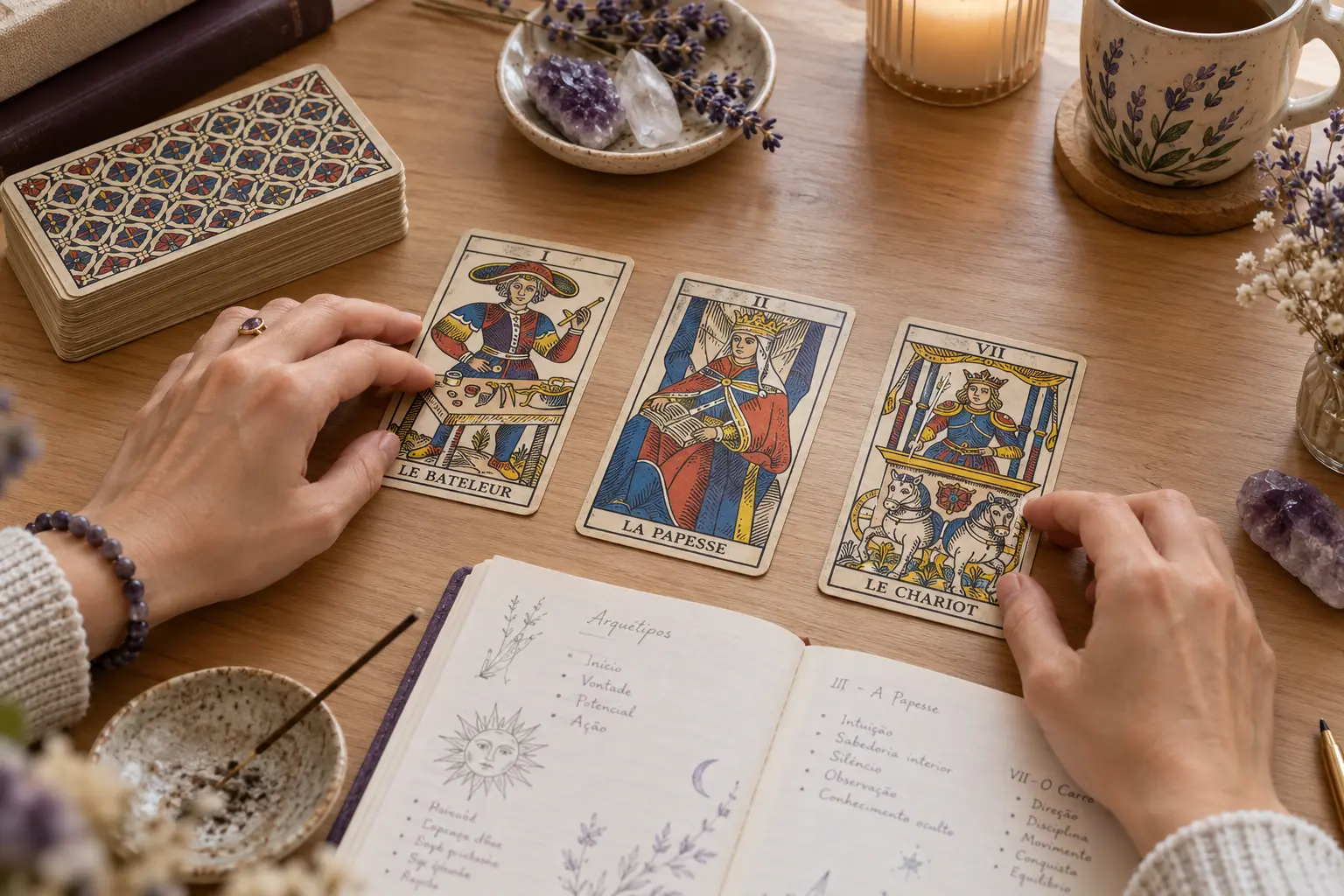
The first step in learning Tarot de Marseille is not memorising seventy-eight definitions. It is understanding what you can see and how the image relates to a question. This guide offers a way to begin studying. A symbolic reading can support reflection; it cannot provide evidence about other people or guarantee events.
One deck, two families of cards
The deck contains 78 cards: 22 Major Arcana and 56 Minor Arcana. The Majors show recognisable figures and situations, such as the Magician, Justice and the Chariot. They can draw attention to learning and broader themes. The Minors are organised into four suits: Wands, Cups, Swords and Coins. Each suit has ten numbered cards and four court cards: Page, Knight, Queen and King.
In the numbered Marseille cards, objects and visual composition play a central role. Do not confuse these designs with the illustrated scenes of other systems, such as Rider–Waite–Smith. Observe the deck in front of you. Different editions and conventions exist; identify yours before comparing interpretations.
Choose a question you can work with
A useful question defines the subject and preserves your ability to decide. “What factors should I consider before accepting this job?” lets you explore preparation, resources and difficulties. “On what day will I be hired?” asks for certainty that the cards cannot demonstrate.
Write down the question before drawing cards. If you change it after seeing the result, it becomes difficult to know what you are answering. To practise this skill, try the guide to Tarot questions.
Separate observation from interpretation
Choose a card and write three observations: how many figures appear, what objects you see and which direction they seem to move in. Only then add a symbolic hypothesis. For example, the Magician standing before a table may suggest available resources and a beginning that calls for experimentation. This differs from claiming that someone will achieve everything they want.
For a work question, you could explore existing skills and a small first experiment. In a relationship question, the same card could draw attention to an initiative in communication. The subject changes the application; the image does not become an instruction.
Add neighbouring cards
Start with two cards. Imagine the Magician followed by Justice in a question about launching a service. The Magician may point towards testing an idea with the resources at hand. Justice introduces criteria: conditions, boundaries, commitments and evaluation. Their relationship might be expressed as: experiment, but decide in advance how to assess the trial and what has been agreed.
This reading connects the cards. Simply adding “beginning” to “balance” is not enough. Ask how one action can organise the other. Then move to a three-card spread, with defined positions.
Seven days of practice
For the first two days, observe one card each day and distinguish description from hypothesis. Over the next two days, apply the same card to two different questions. On day five, relate two cards. On day six, practise three positions. On day seven, review your notes without retrospectively changing the initial interpretation.
Keep three fields in your notebook: observation, hypothesis and possible action. Add a question where you are uncertain. Recognising what you cannot yet interpret is a skill, not a failure.
How to tell whether you are learning
A consistent interpretation answers the question, respects the position, describes observed elements and ends with proportionate guidance. If you only repeat keywords, return to the image. If you make claims about another person’s secret feelings, reframe the reading around the experience and choices of the person consulting.
Do not use cards to diagnose health conditions, decide investments or replace professional advice. To continue with lessons, exercises and assessments, explore the Tarot de Marseille course with Ana Reis. Its public programme helps you decide whether the training matches your aim. The lessons and learning materials are in Portuguese.